For 4 decades, Antarctic sea ice defied the Arctic trend, holding steady and even expanding slightly while northern ice declined. Then, in 2016, extent fell by what Professor Alberto Naveira Garabato recalls as “nearly 20% within a few months”, and it has stayed low since.
Alberto, Regius Professor of Ocean Sciences at the University of Southampton and recently elected to the Fellowship of the Royal Society, argues that the Southern Ocean sits closer to the centre of our climate than its remoteness suggests.
“We tend to think of these places as far away, and not really affecting us. But that’s not at all true. The climate in which we live has a lot to do with how the ocean flows and interacts with these regions far away.”
Professor Alberto Naveira Garabato
Why it changed so abruptly, and what it means for the wider climate, is now the focus of SYNCHRONY, a 4-year project in which Alberto and colleagues will combine satellite and in situ observations to reconstruct how the Southern Ocean has changed.
The questions behind the work
Alberto’s research asks how the ocean works and how it shapes our climate. He focuses on turbulence: the swirling currents, from centimetre-scale ripples to eddies 100 kilometres across, that carry heat, carbon and freshwater around the planet. They form where the ocean meets the atmosphere, the seabed and the ice, and they are hard to simulate because ocean currents are far smaller than the winds that drive the atmosphere.
Although turbulence is ephemeral and small in size, it is important in determining how the ocean and ice influence one another. For example, the winter freezing of the Southern Ocean surface produces turbulence that mixes warm deep waters up toward the surface, melting some of the newly formed ice. This moderating mechanism ‘broke down’ in part as the Antarctic sea ice collapsed in 2016.
The practical question is how fast heat reaches the floating ice around Antarctica and Greenland, and so how quickly sea level will rise. The deeper one is whether the ocean will keep moderating climate change for us, or as Alberto asks: “whether it is going to fail us at some point”.
A shift nobody predicted
In 2025, Alberto and a Southampton team led by Dr Alessandro Silvano, with Dr Aditya Narayanan, reported that the Southern Ocean’s surface had become saltier. Combining European satellite data with robotic floats that profile the water column, they showed that surface water south of 50°S, which had been freshening since the early 1980s, had reversed course.
The consequence lies in the ocean stratification. For decades, the surface freshening strengthened the lid, insulating the sea ice from the warmer, saltier water beneath and helping to sustain the ice cover. A saltier surface weakens that barrier, so subsurface heat can reach the surface and melt ice from below.
For Alberto, the surprise was the heat source. “A lot of the melting of the sea ice was not related to the warming of the atmosphere above. It came from below.” That deep water is only a degree or two above zero, but that is well above the freezing point of sea ice, and most of it normally stays at depth, “minding its own business”. Now a large amount of it was reaching the surface.
The signs are dramatic. Since 2015, Antarctica has lost an area of sea ice comparable to Greenland, and the Maud Rise polynya, an open-water hole in the Weddell Sea nearly 4 times the size of Wales, briefly returned after decades.
The signal spreads
But the change is not confined to the surface. New research involving Alberto and his colleagues reports that Antarctic Intermediate Water, a layer that carries fresh water across much of the Southern Hemisphere’s oceans, has rapidly reversed its long-term trends.
From 1995 to 2015, summer melt from Antarctic sea ice kept the layer fresh. From 2016 to 2024, with less meltwater, it became saltier, denser and deeper. The team describes this as the first direct observational evidence of the shift, based on data from the global Argo float network together with satellite and atmospheric datasets.
“As this altered, saltier and denser water mass travels north, it moves across the Atlantic, Indian and Pacific oceans,” Alberto explains. “Because this water layer forms part of the upper limb of the ocean's global ‘overturning circulation’, a sustained shift could, over years to decades, feed into the Atlantic Meridional Overturning Circulation – the deep-ocean current system often linked to climate stability in the North Atlantic.”
What it could mean
Sea ice does more than reflect the sunlight. Alberto frames the ocean as 2 layers: a warm, carbon-poor upper layer and a colder, carbon-rich lower one, with Antarctic sea ice helping to set the boundary between them. As the ice retreats, that boundary is deepening, so the upper layer thickens and the lower one thins. This changes the ocean’s capacity to store heat and carbon. The Southern Hemisphere is already responding, and he expects the signal to reach the north within decades; Antarctic sea ice doesn’t recover.
“We are fundamentally changing the structure of the ocean and its ability to retain heat and carbon. I can’t tell you exactly how big, or when, because we are still trying to process all this, but something quite profound is going on.”
Predictability is the central difficulty. The system is rich in feedbacks and sensitive to small errors, which grow with time, much as a weather forecast is reliable for days rather than weeks. But the direction is not in doubt: the planet is warming, the ocean is taking up heat and carbon, and sea level will rise. The uncertainty is the pace. Current understanding “may be insufficient” to predict the rate of future change, and Alberto is sceptical of some model projections that ocean circulation will slow. He adds: "That is why the next five to ten years matter."
"We need to understand this system well enough to make more confident statements about what to expect. Societally, that’s important: we want to know whether the ocean will keep moderating climate change for us, or whether it is going to fail us at some point."
Professor Alberto Naveira Garabato
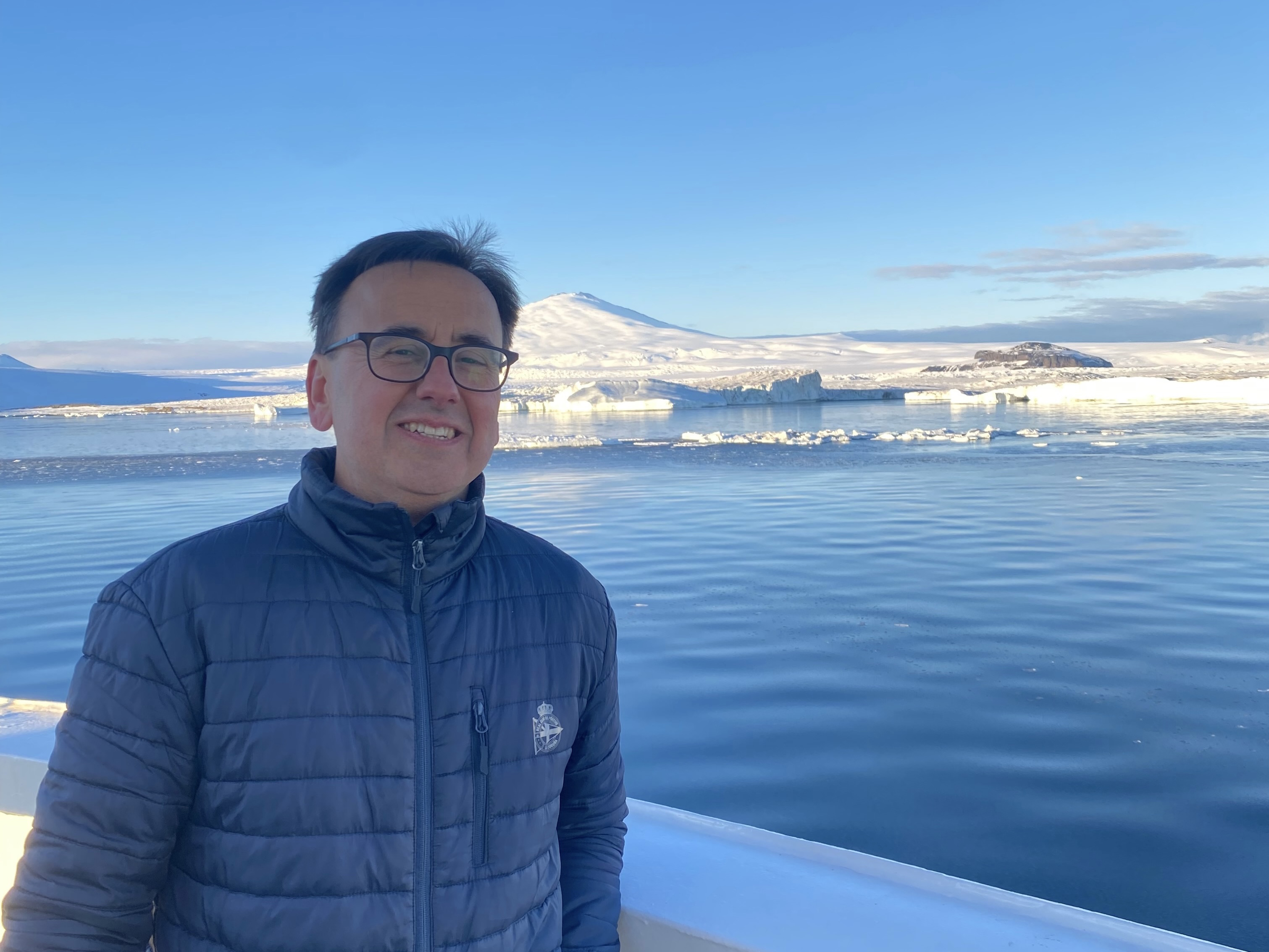
From discovery to a coordinated observing effort
Closing this gap is where SYNCHRONY comes in. The €8.5 million EU-funded project involves 27 institutions, including Southampton, and is coordinated by the Alfred Wegener Institute. It is part of Antarctica InSync, an international programme that will send ships and other assets to take a coordinated snapshot of the Antarctic and its surrounding ocean. Alessandro Silvano and Alberto will combine satellite and in situ observations to reconstruct recent changes in circulation and sea ice, and to test what ice retreat means for the wider climate.
Why Southampton?
Southampton’s ocean scientists work alongside the National Oceanography Centre, a national facility, enabling researchers to come together on projects and apply for new funding.
The breadth extends beyond physical oceanography: marine biogeochemists on the carbon cycle, engineers building robotic observing platforms, mathematicians behind the simulations, and physicists studying the oceans of icy moons.
The expertise is across all peer groups too from seasoned Professors to early-career researchers. For example, Bieito Fernandez Castro, a Lecturer in Physical Oceanography at the University of Southampton, is leading the POLEMIX project, a £5 million ARIA-funded project, that is deploying autonomous profiling floats to measure ocean mixing in the North Atlantic Subpolar Gyre. Its data will feed ocean and climate models to help scientists judge whether, when and how close the gyre is to a tipping point.
Alberto says: “The opportunities our teams have are boundless. It’s a vibrant, dynamic research environment that enables everyone to thrive. That’s something you don’t find in many other places.”
Beyond Earth
Alberto’s group also applies its ocean models well beyond Earth. Jupiter and Saturn have icy moons with oceans beneath ice shells tens of kilometres thick, so the oceans can’t be seen directly. Their existence is inferred from how the moons move and from the magnetic field around them. With almost no observations to constrain the models, working with Southampton physicists, the group is building simulations from first principles and adds complexity step by step, asking what happens if one thing changes and then another. The aim is predictions that can be tested.
The European Space Agency and NASA missions are due to start returning measurements in about 5 years, and Alberto wants testable predictions ready by then. One main question is whether these oceans could host life, perhaps with volcanic activity at the seafloor, as in the early Earth. “We can’t answer the questions just by ourselves,” he says, “but there are some things that we can do with our models that can inform those questions.” He sees the work as pure curiosity with no obvious practical application: “If you get into science, you want to do a little bit of this.”
Responsibility and motivation
Back on Earth, however, Alberto feels a responsibility to contribute to the fight against climate change. His group isn’t “right in the firing line” of the applied work on mitigation, but he sees its role as supplying the evidence that decisions depend on.
“We are the ones who dig up the really important information to ensure that we survive. Not in terms of the next few years, but in the decades to come."
Professor Alberto Naveira Garabato
“Houses will still be standing in 200 years’ time, but you need to know where to build them and what part of the coastline will be gone by then. The question for my field, is how to limit the harm by providing the best possible information."
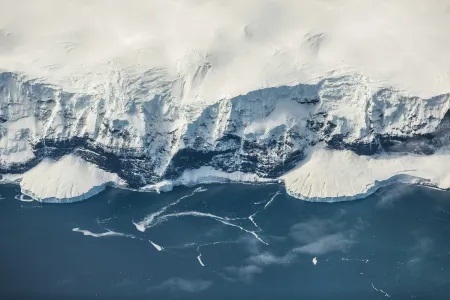
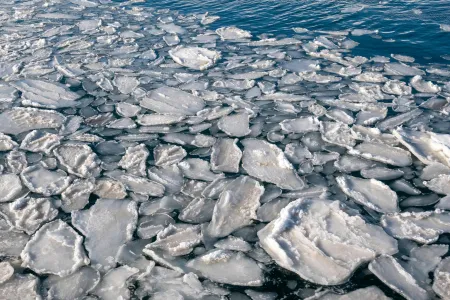
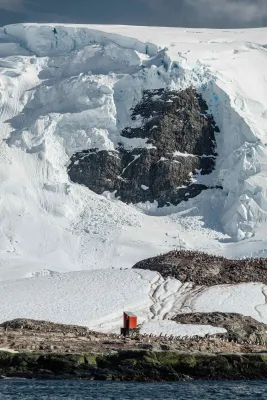
Being in the remote parts of the world that we study, like Antarctica, gives you motivation too - it’s like being on another planet. You don’t see any trace of humans. You feel very small. But those places are changing because of what we do. It just emphasises how interconnected everything is.