About
Current research includes fundamental studies of poled glasses with large second-order nonlinearities, the creation of new glasses, optical fibres and waveguides with nonlinearity comparable with that in the best nonlinear crystals, and development of practical devices such as all-fibre frequency doublers, parametric frequency converters, electro-optic modulators, switches and electric field sensors.
Another activity involves advanced photosensitivity and femtosecond direct writing of 3D photonic structures. Photonic structures patterned in three dimensions providing entirely new functionalities offer tantalising possibilities in the field of integrated optics, for example switches and compact delay lines, and micro-optics, for example embedded diffractive optics arrays for interconnection and synthesis of light beams.
Current interests and future directions also include integrated quantum optic devices, such as atomic clocks, atom interferometers and quantum computers. The field of laser cooling and trapping atoms for cold atom optics promises numerous important applications and we are working to advance this technology and create a cold atom laboratory on a microchip.
The world's most durable digital storage medium
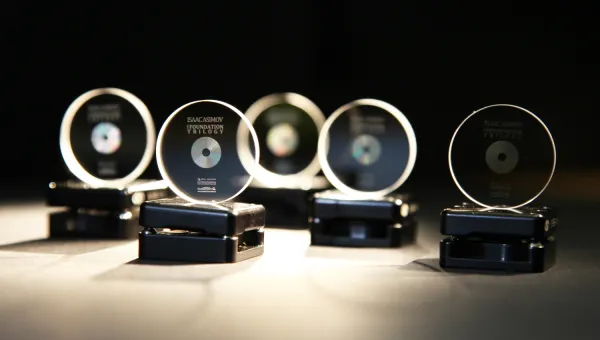
Professor Peter Kazansky has found a way to store data on near-indestructible glass that could last for billions of years. The glass is featured in Guinness World Records as 'most durable digital storage medium'.
With the help of Nova Spivack of the Arch Mission Foundation, they aim to secure human history, art and culture in space for eternity.
Watch a news report about the project on YouTube
Project Silica
We are working with Microsoft on Project Silica, a project to develop the first ever storage technology designed and built from the ground up for the cloud.
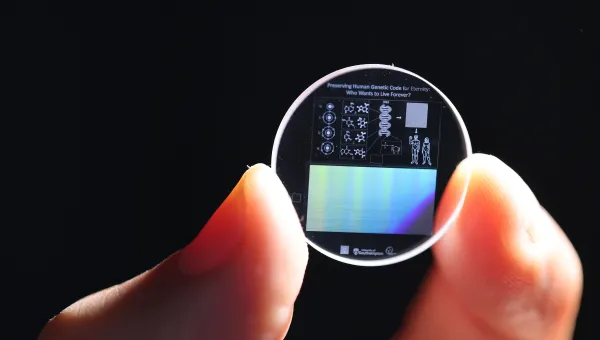
Preserving DNA in everlasting memory crystals
Scientists at the University of Southampton have successfully stored the full human genome (or complete set of DNA) onto a 5D memory crystal – an achievement which could hold the key to restoring life after extinction.
-

Fitting an entire library into the palm of your hand
Scientists at the Optoelectronics Research Centre have developed a digital data storage solution that can contain the complete history of human knowledge – and is able to survive for billions of years.