

About
General Relativity predicts the emission of gravitational waves during the inspiral and coalescence of systems of black holes and neutron stars. In order to interpret and facilitate the detection of gravitational waves from these, detailed theoretical understanding of general relativity and spacetimes around black holes and neutron stars is required. Members of the Gravity group study the gravitational collapse and formation of black holes, the dynamics of matter around black holes, and the gravitational radiation-reaction-driven merger of systems of neutron stars and stellar mass, intermediate mass, and supermassive black holes.
Neutron stars are invaluable laboratories for probing the state of matter under extreme conditions, and observations of neutron stars provide complementary information to that obtained from particle accelerators such as the Large Hadron Collider. Members of the Gravity group model the complex physics of neutron stars (including supranuclear physics with magnetohydrodynamics and exotic phases of matter like superfluids, superconductors, and deconfined quarks) and the observational signatures of these physics (for example as seen from radio and X-ray pulsars as well as gravitational waves from neutron star mergers).
Find out more about our regular Gravity seminars.
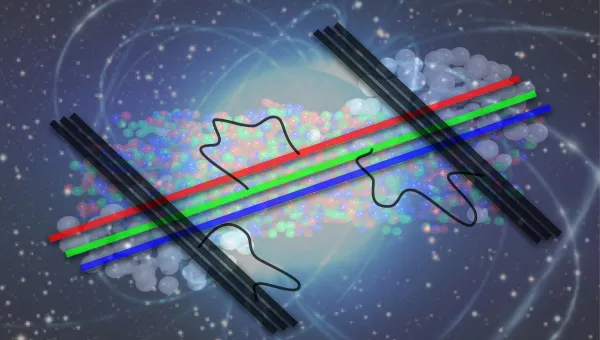
Shining a light on neutron stars with string theory
Southampton research is pushing forward the frontiers of our understanding of the fundamental laws of nature by revealing insights into the interiors of neutron stars.
People, projects, publications and PhDs
People
-

Professor Adam Pound
Professor of Theoretical PhysicsGeneral Relativity
Sources of gravitational waves
Black holes
Accepting applications from PhD studentsEmail: A.Pound@soton.ac.ukTel: +44 23 8059 7375 -
Professor Andreas Schmitt
ProfessorQuantum chromodynamics
Accepting applications from PhD studentsEmail: A.Schmitt@soton.ac.ukTel: +44 23 8059 5114 -
Professor Carsten Gundlach
Professor of Mathematical PhysicsClassical general relativity
Numerical relativity
Accepting applications from PhD studentsEmail: C.J.Gundlach@soton.ac.ukTel: +44 23 8059 5116 -

Professor Ian Hawke
ProfessorNumerical relativity
Neutron Stars
Gravitational waves
Accepting applications from PhD studentsEmail: I.Hawke@soton.ac.ukTel: +44 23 8059 8993 -

Professor Ian Jones
Professor of Mathematical PhysicsGravitational wave astronomy
Neutron stars
Radio pulsars
Accepting applications from PhD studentsEmail: D.I.Jones@soton.ac.ukTel: +44 23 8059 4829 -

Doctor Jezreel Castillo
MSCA Postdoctoral FellowBlack Hole Perturbation Theory
Gravitational Waves
Email: J.Castillo@soton.ac.uk -

Doctor Jonathan Thompson
Lecturer in GravityGravitational wave modeling
Black-hole perturbation theory
Accepting applications from PhD studentsEmail: J.E.Thompson@soton.ac.uk -

Professor Leor Barack
Professor of Mathematical PhysicsClassical General Relativity
Gravitational waves
Black Holes
Accepting applications from PhD studentsEmail: L.Barack@soton.ac.ukTel: +44 23 8059 5134 -
Professor Nils Andersson
Professor of Applied MathsGeneral relativistic astrosphysics
Black holes
Neutron stars
Accepting applications from PhD studentsTel: +44 23 8059 4551
We are opening our eyes to what's out there - the invisible, dark side of the Universe, that we can only reveal through gravitational waves.
Related research institutes, centres and groups
-
Applied Mathematics and Theoretical Physics
We focus on mathematical modelling and mathematical physics, and investigate everything from neutron stars to superfluids. -
Mathematical Modelling
The modelling group focuses on mathematical modelling across science and engineering, including physics (from the physics of quanta and strings to that of liquid crystals), chemistry (modelling lithium-ion batteries and solar cells), engineering (controlling sound direction), biology, medicine and healthcare (from stem cell population dynamics to medical imaging and healthcare models). -
String Theory and Holography
The group works on all aspects of fundamental physics - string theory; quantum field theory; applications to gravity, black holes, cosmology, particle physics, condensed matter and quantum information.