

Change the way we see it
Great research happens when people from different disciplines come together. Professor Sumeet Mahajan talks about the collaborative spirit behind interdisciplinary research at Southampton. (15 seconds)
The driving force to find a cure
As a child, I always liked science and was quite sporty, but I used to suffer from asthma. And unfortunately, at a lot of critical junctures I used to fall ill.
And that became the driving force for me – I thought, “I have to find a cure”. I remember standing up in class, probably year nine, and saying that I wanted to be a scientist when I grew up, and here I am.
I originally thought that a scientist in industry was the right way for me but realised the freedom to develop and execute my ideas lay in academia and the passport to that was a PhD.
Hence, I came to Southampton to do my PhD, in electrochemistry. But it expanded into a collaboration with chemical biologists and then with the physics department, and the Optoelectronics Research Centre – truly interdisciplinary.
After my PhD, I went to the Cavendish Laboratory at the University of Cambridge for my post-doctoral work, but when a position here came up, I came back.
Lighting the way
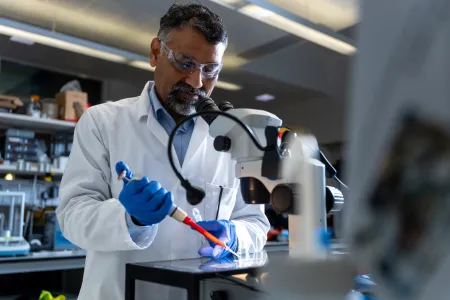
I study the interaction of light with materials, specifically materials that are biological and medical in origin, to learn more about them and how they change in different situations.
In scientific terms, when we talk about light it means the whole electromagnetic spectrum, which spans all the way from gamma rays and X-rays to radio waves.
We tend to work with light from the ultraviolet (UV) to the near infrared and infrared regions, which means light just beyond the visible, that the human eye can’t see.
To be useful, it must be accessible
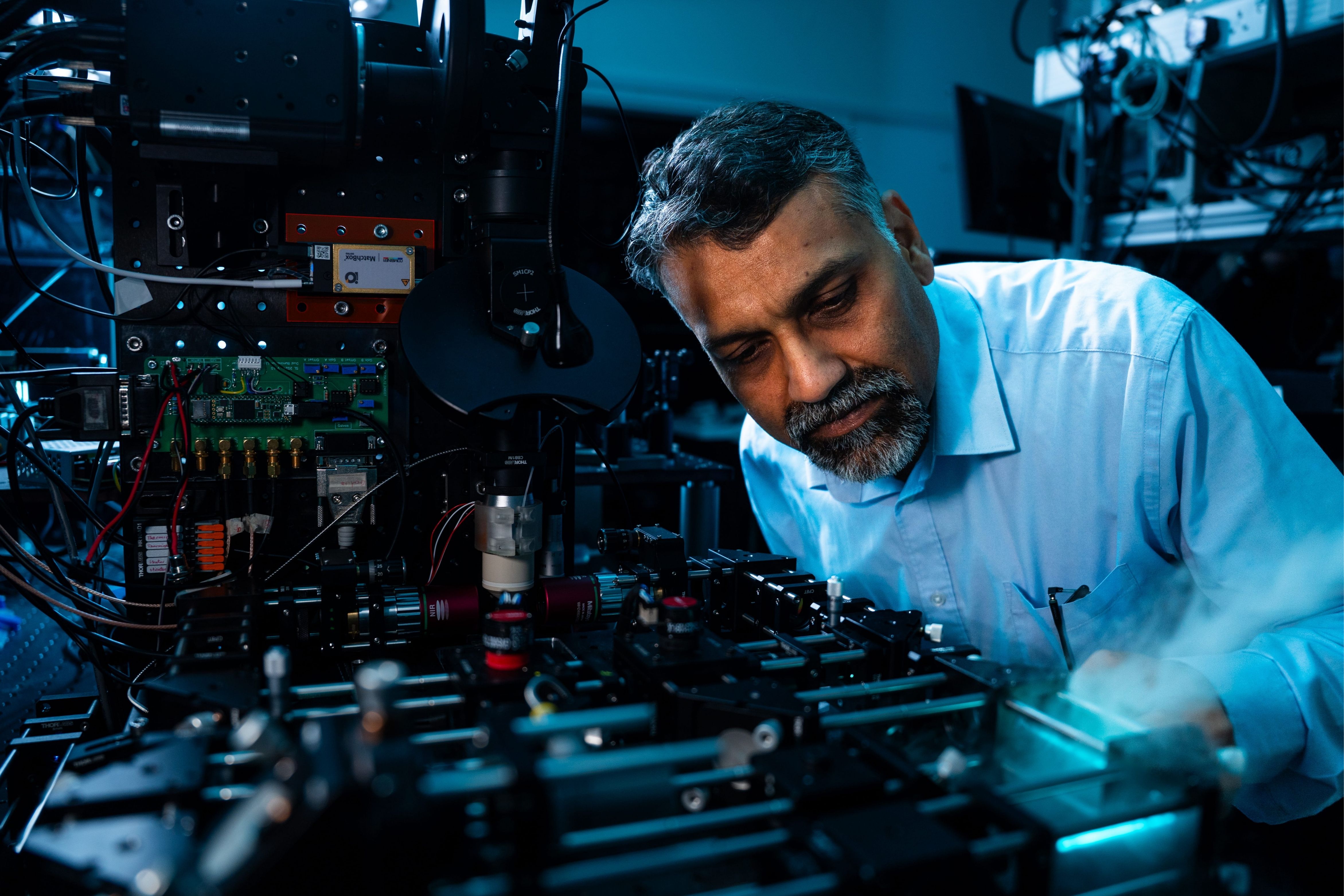
We use Raman spectroscopy and its various versions.
This is a technique where a laser provides the energy to make molecules vibrate. Each vibration is specific to the atoms and chemical bonds that are present and therefore we can determine a structural and molecular fingerprint of a substance.
Once you get that insight into what a substance is made of, how it interacts with other things at the molecular level, how the molecular composition changes, you can develop better understanding of disease mechanisms and therefore be able to better design a new generation of treatments and ways of monitoring diseases.
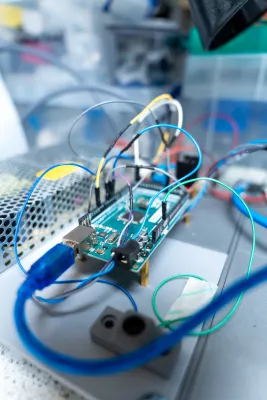
But a barrier to using this technique is accessibility. Needing a machine and a lab to test samples is inconvenient. For it to be more useful, we realised we would have to design systems that allowed it to be used outside the lab in the real world.
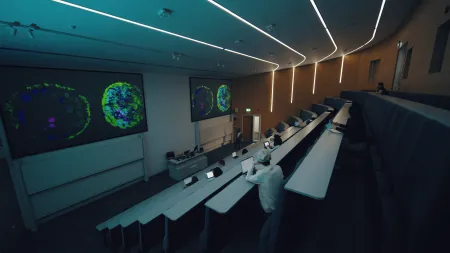
Imagine in 20 years that you could walk through an archway scanner like at airport security, and non-damaging lasers could give you a whole-body profile – what diseases you might have right now, or what you might develop in 10 years.
That’s the vision, the dream, and we will get there one day, I’m sure.

Imagine in 20 years that you could walk through an archway scanner like at airport security, and non-damaging lasers could give you a whole-body profile – what diseases you might have right now, or what you might develop in 10 years. That’s the vision, the dream, and we will get there one day, I’m sure.
A simple home test to detect a devastating disease
At the moment, we are focusing on dementia and Alzheimer’s disease.
There are 55 million people with dementia worldwide, and 500 million people at risk, which means almost 1 in 5 people are going to have dementia at some point in their lives.
We are working on creating a simple finger prick blood test, or patch on your shoulder that can be sent to you through the post and easily used at home.
This test could tell you whether you have, or you're developing, early signs of dementia, or your likelihood of developing dementia within 10 years.
From drug discovery to marine conservation
We are also looking at the effects of microplastic and nanoplastic pollution on corals in the marine environment.
At that scale, these plastics are invisible to the eye, but they affect everything. They get taken up by the smallest organisms in the ocean and then become more concentrated as they go up the food chain.
We’ve been looking at how they have been taken up by corals and what damage they might be causing coral reefs.
With Raman, we can see if the coral polyps are ingesting the plastics and the effects on their health as the plastics become embedded in the coral skeletons.
This then gives our ocean scientist colleagues here at Southampton valuable information about the health of these marine creatures and ecosystems.
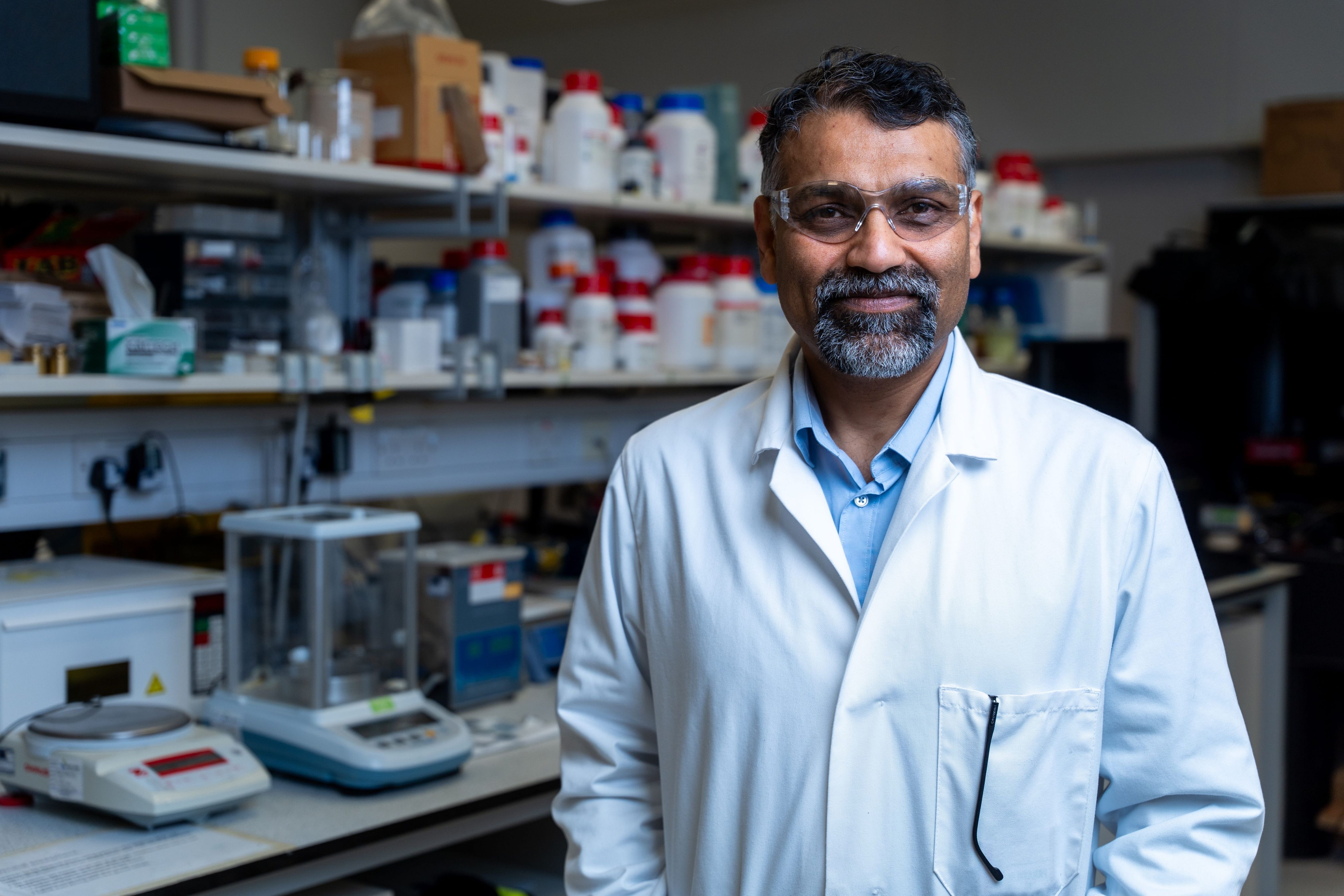
Always pulling in the same direction
I come from an Indic philosophical system, which encompasses the thinking that you can reach the same truth through multiple paths.
And these personal values fit so well with what the University is trying to achieve. Here we work together, all bring our own experiences and backgrounds, look at problems from lots of different perspectives and find the best solution as one.
While there may be other places in the world that also give the freedom to explore ideas and follow one’s passions as an academic, Southampton was the right one for me.
Related courses
Sumeet teaches on a range of undergraduate, postgraduate taught and research courses:
BSc Chemistry BEng Chemical Engineering MEng Chemical Engineering MChem Chemistry
Explore related pages
Read more of our people's stories
Clothes that work harder – beyond the fashion statement
We see beyond fashion to e-textile garments that could give us back our independence after an injury or illness.
Getting cold to find out how we’ll cope with hot
We go out of the lab to inhospitable places to find the answers, so policymakers can plan and mitigate climate change.
In the face of adversity, some things don’t change
When Becca’s world turned upside down after meningitis and sepsis, her determination to become a doctor remained constant.


