

About
Research areas
Marine solutions and economies are expanding along with increasing threats to the marine environment. Harnessing progress in digital oceans is essential for addressing global and local challenges.
Digital Oceans focuses on advances in marine digital technology, in areas such as:
- artificial intelligence
- data infrastructure and management
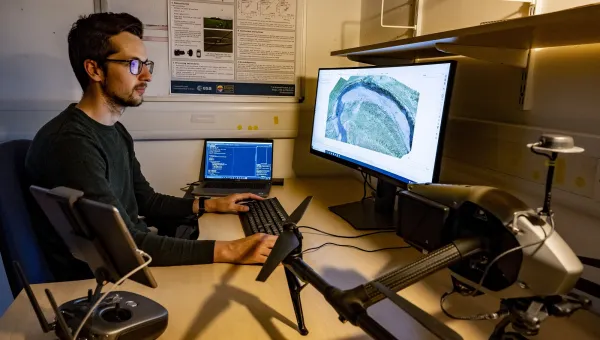
- ocean mapping
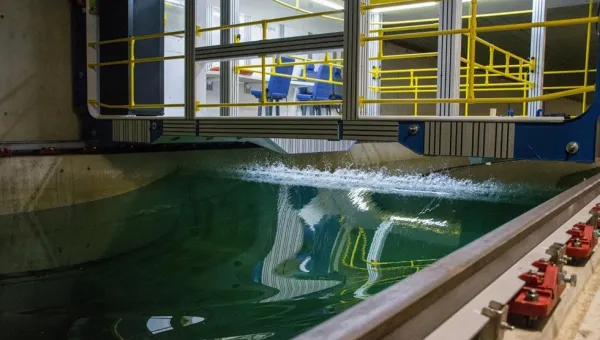
- simulation
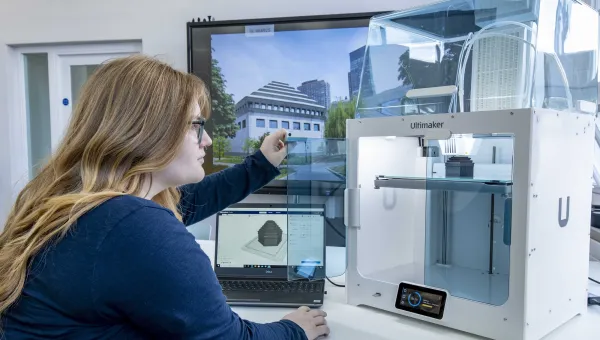
- visualisation such as digital twins
Digital Oceans is a special interest group that aims to establish a collaborative platform for researchers to engage in marine digital applications and methods. Their interest is in a deeper understating of our oceans and in data-driven insights that can inform sustainable practices. They use digital innovation to address practices and changes affecting our marine environments.
Digital Oceans facilitates efficiency and accessibility. This is achieved through advances in artificial intelligence that improve data analysis and decision-making processes; the optimisation of data structures and management; and new frontiers in ocean mapping, simulation and visualisations.
Our ambition is to:
- promote and champion Digital Oceans
- increase awareness to marine digital technologies
- foster collaborations and the exchange of ideas
The Digital Oceans group strives to bridge the gap between cutting-edge marine digital technologies and social and human sciences.
Our vision is to promote environmental stewardship and help innovations to impact our oceans and the global community.
To find out more about the Digital Oceans Special Interest Group and what we do, get in touch with group champions Alexandra Karamitrou, Philip Leadbitter and Hugo Putuhena.
Join the SMMI Community to sign up to this group and our other special interest groups.
People, projects and publications
People
-
Mr Cal Pols
Shipwrecks
Marine Geospatial Data
Automated Methods for Seabed Survey
Email: C.Pols@soton.ac.uk -
Professor Carlos Ponce De Leon Albarran
Professor of Electrochemical EngineeringElectrochemical energy conversion
Water treatment technology
Tel: +44 23 8059 8931Address: B30, East Highfield Campus, University Road, Southampton, SO17 1BJ -
Doctor Catherine Rychert
Associate ProfessorEmail: C.Rychert@soton.ac.ukTel: +44 23 8059 8663Address: National Oceanography Centre, Waterfront Campus European Way, Southampton, SO14 3ZH -
Doctor Cathy Lucas
Associate ProfessorThe role of gelatinous zooplankton in ecosystem structure and function.
Accepting applications from PhD studentsEmail: C.H.Lucas@soton.ac.ukTel: +44 23 8059 6617Address: National Oceanography Centre, Waterfront Campus European Way, Southampton, SO14 3ZH -
Doctor Cecilia D'Angelo
Associate ProfessorEmail: C.Dangelo@soton.ac.ukTel: +44 23 8059 8046Address: National Oceanography Centre, Waterfront Campus European Way, Southampton, SO14 3ZH -
Mr Cedric Muscat
Offshore renewable energy
Geospatial assessment
Email: Cedric.Muscat@soton.ac.uk -
Celia Prescott
Eastern Mediterranean
Coastal geoarchaeology
Email: C.Prescott-Decie@soton.ac.ukAddress: B65a, Avenue Campus, Highfield Road, Southampton, SO17 1BF -
Emeritus Professor Charles Banks
Controlled anaerobic and aerobic biodegradation of municipal and industrial solid waste
Email: C.J.Banks@soton.ac.ukTel: +000Address: Boldrewood Campus, Burgess Road, Southampton, SO16 7QF -
Miss Chloe Crowther
A political ecology of AI marine technologies
Email: cc2c20@soton.ac.uk -
Professor Chris Armstrong
Professor of Political TheoryGlobal justice
Climate justice
Ocean justice and ocean politics
Accepting applications from PhD studentsEmail: C.Armstrong@soton.ac.ukTel: +44 23 8059 3072Address: B58, West Highfield Campus, University Road, Southampton, SO17 1BJ
Related research institutes, centres and groups
-
Centre for Maritime Archaeology
We are a world leading centre for maritime archaeological research and education. We offer cutting-edge training and hands-on learning opportunities, shaping the future of maritime archaeology. -
Southampton Geospatial
The Southampton Geospatial team has the tools and expertise to collect, combine and interpret datasets about locations. -

Southampton Institute for Arts and Humanities
We build interdisciplinary expertise across the University of Southampton and beyond to benefit the lives of our regional, national, and international communities. -
Southampton Marine and Maritime Institute
We work with partner organisations to tackle global marine and maritime challenges, from developing green technologies to influencing government policy. -
Web Science Institute
We study the relationship between society and the largest information system in history: the World Wide Web.