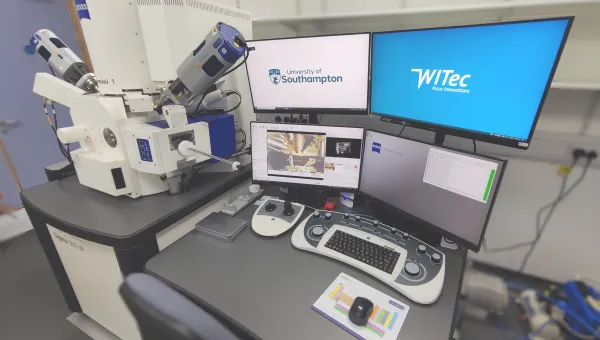
SEM with EDS and correlative Raman
Zeiss Sigma 500 VP FESEM
Field Emission Source - 20 nA configuration
Resolution: 0.8 nm at 15 kV, 1.4 nm at 1 kV
Imaging Detectors:
- SE2
- AsB
- InLensDuo SE & BSE (energy selective)
- C2D for VP mode
- SCD (specimen current detector)
- 80 mm Air-lock for sample transfer
- XEI Evactron E50 Plasma Cleaner
- SemiLab air-sensitive sample shuttle
Oxford Instruments dual-EDS
- Ultim X-Max 170 mm2
- Ultim Extreme 100 mm2 windowless
- sub 10 nm mapping possible
- mapping at <5 kV possible
- Aztek Advanced Software
- LayerProbe for thin film analysis
(layer thickness and composition correction)
WITec RISE – Correlative Raman
- 532 nm laser diode / 32 mW
- 100x objective 0.75 NA
- 600 & 1800 gratings
- ~432 nm spot size
scanning/mapping done by piezo-stage objective - acquisition modes: point spectrum, line scan, mapping (area, depth and 3D).
- data processing with Project Six
Catalyst Reactivity Characterisation
Micromeritics AutoChem III
Pfeiffer OmniStar GSD 350 - Quadrupole Mass Spectrometer
A fully automated catalyst characterization system that uses highly sensitive temperature-programmed techniques (TPR, TPD, TPO) and pulse chemisorption to precisely quantify active surface area, metal dispersion, and surface reactivity.
- pulse chemisorption
- TPR (Temperature Programmed Reduction)
- TPO (Temperature Programmed Oxidation)
- TPD (Temperature Programmed Desorption)
- TPSR (Temperature Programmed Surface Reaction)
- dynamic B.E.T. (Brunauer–Emmett–Teller)
- breakthrough curve
- metal dispersion
- metal surface area
- active surface area
- crystallite size
- heat of desorption
- activation energy
- B.E.T. Surface Area
- metal-supported catalysts
- acid or base catalysed reactions
- oxide or zeolite catalysts
- advanced battery anode materials
- fuel cell catalysts
- Temperatures up to 1200 °C
X-Ray Diffraction
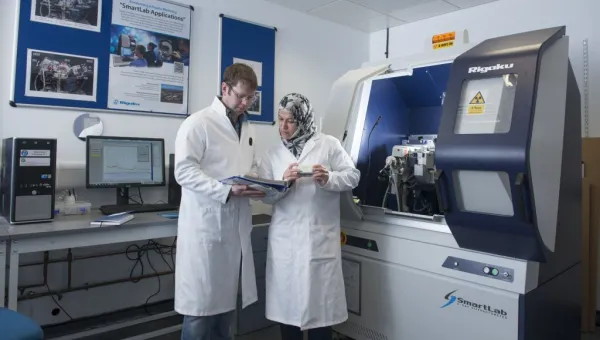
Rigaku SmartLab
The powder and materials diffraction facility offers a range of capabilities from simple phase identification through to complex materials analysis.
Available techniques include:
- X-Ray reflectivity for film thickness measurements
- low angle diffraction for mesopore characterisation
- grazing incidence diffraction for thin film characterisation
- measurement of engineered samples such as steel and coated surfaces
- phase identification of clays and minerals
- characterisation of ceramics
- percentage crystallinity of polymers
- reciprocal lattice mapping for epitaxial systems
- pole figure measurement for texture analysis
- residual stress determination
- high temperature measurements (up to 1000°C) in vacuum or inert atmospheres
- in-plane diffraction and microdiffraction (50 microns) for sample mapping
- capillary measurements for air sensitive samples.
The Rigaku SmartLab thin film and materials X-ray diffractometer is a highly versatile, high-resolution instrument.
Bruker D6 Phaser
- routine powder measurements and thin film possible.
Raman Microscopy
Renishaw inVia Confocal Raman Microscope with 785 nm laser
- 785 nm laser source at 50 mW max power output
- line focus profile at ~20x5 µm spot size
- 1200 gr/mm grating
- automated stage for line scans or mapping
- X5, X50 LWD and X50 0.9NA objectives
Raman occupies the vibrational spectroscopy space, where molecular vibrations or phonon modes inelastically scatter photons and shift their wavelength. This provides a spectroscopic fingerprint of a wide range of compounds and materials, with applications in, among others:
- chemistry
- physics
- biology
- polymers
- pharmaceuticals
FTIR
Thermo Scientific Nicolet iS5
- ATR iD7 – Diamond KBr
- iD1 – Transmission
- spectral Range: 7800 – 350cm-1
- signal-to-noise: 5 secs: 8000:1 (5s scan)
Surface Area and Porosity Analyser
Micromeritics TriStar II BET
- pressure range 0 to 950 mmHg ±0.05 mmHg, within 0.5% accuracy
- relative pressure range 0 to 1 P/P0 with resolution of 0.0001
- specific Surface Area 0.01 m2/g with nitrogen
- total Surface Area 0.1m2 with nitrogen
- pore volume 4×10⁻⁶ cm3/g
- free space measurement uses helium
Nitrogen physisorption using a liquid nitrogen bath.
Other gases possible (CO2 , CH4) using the ISO Controller bath with temperatures -5 – 80 °C.
Differential Scanning Calorimetry - DSC
TA Discovery 1 DSC
A Differential Scanning Calorimeter (DSC) measures the difference in heat flow between a sample and a reference as they are heated or cooled, allowing you to identify thermal transitions like melting points, glass transitions, and chemical reactions.
- temperature range -180 to 550 °C
- LN2P Cooler
- auto sample changer
- max cooling rate 140 °C/min
- max heating rate 200 °C/min
- ~0.02 µW resolution
Thermogravimetric Analysis - TGA
Netzsch TG 209 F1 TGA
A Thermogravimetric Analyzer (TGA) measures the change in a sample's weight as a function of temperature or time in a controlled atmosphere, allowing you to determine thermal stability, filler content, and compositions.
- temperatures up to 1100 °C
- heating rates 0.001 to 200 K/min.
- sample weight 2000 mg max at 0.1 µg resolution.
- three mass flow controllers
- gases typically set up: Argon and Oxygen
- c-DTA (calculated DTA)
- water cooled