Explore how physical and human systems interact to shape our planet. On this BSc Geography degree, you’ll gain the scientific and analytical skills to understand natural processes, environmental change and the challenges impacting people and places today.
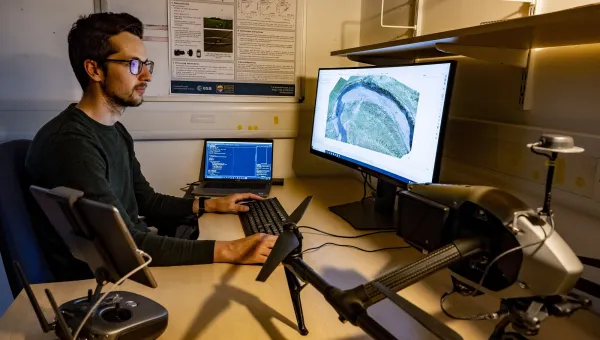
Over 3 years, you’ll study both human and physical science aspects of geography and specialise in physical geography as you progress. You’ll learn how to investigate and interpret the natural world through classroom learning, fieldwork and lab work, developing advanced techniques such as:
Geographical Information Systems (GIS)
remote sensing
spatial analysis
Learn from leading experts
You’ll be taught by researchers from a top UK geography department. Their expertise in environmental change, climate systems and sustainability will guide your development as a geographer and scientist.
With their support you'll cover topics that interest you, with opportunities to study topics from glaciers to dessert landscapes or climate change and human-coastal interactions.
Practical learning and field experience
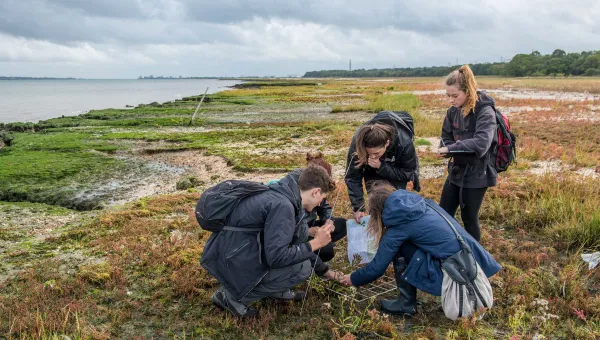
There are several opportunities for practical experience throughout this degree helping you understand environmental processes in real contexts and prepare you for professional practice. Alongside lab work, field activities are built into every year of study. This includes a first-year field course in the New Forest, residential trip to Tenerife included in your tuition fees and an optional third year trip to the Swiss Alps, Cambodia or Namibia.
Partnership Projects
Our Partnership Projects initiative gives you the opportunity to complete a Policy, Practice or Industry dissertation in collaboration with an external organisation.
You’ll work on a real brief set by the partner, applying your knowledge to a defined challenge.
Projects may include:
ecological field studies
social research into community sustainability initiatives
identifying new locations for environmental or social charity work
Your research will focus on real-world issues and contribute to practical outcomes.
Support and community
Your personal academic tutor will support your academic and professional development, helping you choose modules and plan your career.
You can also:
complete a paid internship or a year in employment
study abroad through our global exchange network
Our welcoming and supportive Geography society also hosts a range of academic and social events all year, providing community and additional opportunities throughout your degree.
We regularly review our courses to ensure and improve quality. This course may be revised as a result of this. Any revision will be balanced against the requirement that the student should receive the educational service expected. Find out why, when, and how we might make changes.
Our courses are regulated in England by the Office for Students (OfS).
Offers typically exclude General Studies and Critical Thinking.
A-levels with Extended Project Qualification
If you are taking an EPQ in addition to 3 A levels, your offer will be: BBB and Grade A in the EPQ
A-levels contextual offer
We are committed to ensuring that all applicants with the potential to succeed, regardless of their background, are encouraged to apply to study with us. The additional information gained through contextual data allows us to recognise an applicant's potential to succeed in the context of their background and experience. Applicants who are highlighted in this way will be made an offer which is lower than the typical offer for that programme as follows: Grades BBC
or
International Baccalaureate Diploma
Pass, with minimum 34 points overall with 17 points at Higher Level if no prefered subject taken at Higher Level or Pass, with minimum 32 points overall with 16 points at Higher Level if one or more prefered subjects taken at Higher Level.
International Baccalaureate contextual offer
We are committed to ensuring that all learners with the potential to succeed, regardless of their background, are encouraged to apply to study with us. The additional information gained through contextual data allows us to recognise a learner’s potential to succeed in the context of their background and experience. Applicants who are highlighted in this way will be made an offer which is lower than the typical offer for that programme.
International Baccalaureate Career Programme (IBCP) statement
Offers will be made on the individual Diploma Course subject(s) and the career-related study qualification. The CP core will not form part of the offer. Where there is a subject pre-requisite(s), applicants will be required to study the subject(s) at Higher Level in the Diploma course subject and/or take a specified unit in the career-related study qualification. Applicants may also be asked to achieve a specific grade in those elements. Please see the University of Southampton International Baccalaureate Career-Related Programme (IBCP) Statement for further information. Applicants are advised to contact their Faculty Admissions Office for more information.
or
BTEC
RQF BTEC
DDD in the BTEC Extended Diploma. DD in BTEC Diploma plus A in A-level subject or DD in BTEC Diploma plus B in a preferred A-Level subject. D in the BTEC Subsidiary Diploma plus A A from 2 A-level subjects or D in the Subsidiary Diploma plus AB from 2 A-level subjects including at least one preferred subject.
We are committed to ensuring that all learners with the potential to succeed, regardless of their background, are encouraged to apply to study with us. The additional information gained through contextual data allows us to recognise a learner’s potential to succeed in the context of their background and experience. Applicants who are highlighted in this way will be made an offer which is lower than the typical offer for that programme.
Additional information
BTEC Extended Diploma must be in a relevant subject area
QCF BTEC
DDD in the BTEC Extended Diploma. DD in BTEC Diploma plus A in A-level subject or DD in BTEC Diploma plus B in a preferred A-Level subject. D in the BTEC Subsidiary Diploma plus A A from 2 A-level subjects or D in the Subsidiary Diploma plus AB from 2 A-level subjects including at least one preferred subject.
BTEC contextual
We are committed to ensuring that all learners with the potential to succeed, regardless of their background, are encouraged to apply to study with us. The additional information gained through contextual data allows us to recognise a learner’s potential to succeed in the context of their background and experience. Applicants who are highlighted in this way will be made an offer which is lower than the typical offer for that programme.
or
Show more entry requirements
Access to HE Diploma
Irish Leaving Certificate
Scottish Qualification offers
Cambridge Pre-U
Welsh Baccalaureate
T Level
Access to HE Diploma
60 credits with a minimum of 45 credits at Level 3, of which 39 must be at Distinction and 6 credits at Merit or 60 credits with a minimum of 45 credits at Level 3, or which 30 must be a Distinction and 15 credits at Merit if a preferred subject.
Access Offer Contextual
We are committed to ensuring that all learners with the potential to succeed, regardless of their background, are encouraged to apply to study with us. The additional information gained through contextual data allows us to recognise a learner’s potential to succeed in the context of their background and experience. Applicants who are highlighted in this way will be made an offer which is lower than the typical offer for that programme.
Irish Leaving Certificate
Irish Leaving Certificate (first awarded 2017)
H2,H3,H3,H3,H3,H3
Irish Offer Contextual
We are committed to ensuring that all learners with the potential to succeed, regardless of their background, are encouraged to apply to study with us. The additional information gained through contextual data allows us to recognise a learner’s potential to succeed in the context of their background and experience. Applicants who are highlighted in this way will be made an offer which is lower than the typical offer for that programme.
Scottish Qualification
Offers will be based on exams being taken at the end of S6. Subjects taken and qualifications achieved in S5 will be reviewed. Careful consideration will be given to an individual’s academic achievement, taking in to account the context and circumstances of their pre-university education.
D3 D3 M2 if no prefered subject included or D3 M2 M2 if one or more preferred subject is included.
Cambridge Pre-U additional information
Cambridge Pre-U's can be used in combination with other qualifications such as A Levels to achieve the equivalent of the typical offer where grade D3 can be used in lieu of grade A or M2 can be used in lieu of grade B.
Cambridge Pre-U Offer Contextual
We are committed to ensuring that all learners with the potential to succeed, regardless of their background, are encouraged to apply to study with us. The additional information gained through contextual data allows us to recognise a learner’s potential to succeed in the context of their background and experience. Applicants who are highlighted in this way will be made an offer which is lower than the typical offer for that programme.
Welsh Baccalaureate
ABB from 3 A Levels or AB from 2 A levels are included and B from the Advanced Skills Baccalaureate Wales
Welsh Baccalaureate additional information
Offers typically exclude General Studies and Critical Thinking.
Welsh Baccalaureate contextual offer
We are committed to ensuring that all learners with the potential to succeed, regardless of their background, are encouraged to apply to study with us. The additional information gained through contextual data allows us to recognise a learner’s potential to succeed in the context of their background and experience. Applicants who are highlighted in this way will be made an offer which is lower than the typical offer for that programme.
T-Level
An overall Distinction with grade A in the core element and a Merit in the Occupational Specialism in the following T-levels:
Science
Animal Care and Management
Agricultural, Land Management and Production
Other requirements
GCSE requirements
Applicants must hold GCSE English language (or GCSE English) and Mathematics at minimum grade 4/C.
If English is not your first language, you must show that you can use English to the level we require. Visit our English language pages to find out which qualifications we accept and how you can meet our requirements.
If you are taking the International English Language Testing System (IELTS), you must get at least the following scores:
IELTS score requirements
overall score
6.5
reading
6.0
writing
6.0
speaking
6.0
listening
6.0
If you do not meet the English language requirements through a test or qualification, you may be able to meet them by completing one of our pre-sessional English programmes before your course starts.
GCSE requirements
Most courses require GCSE English Language (or GCSE English) and GCSE Mathematics at grade 4/C or above, or an equivalent qualification accepted by the University. Please check the ‘UK students’ tab for this course’s specific requirements.
You might meet our criteria in other ways if you do not have the qualifications we need. Find out more about:
skills you might have gained through work or other life experiences (otherwise known as recognition of prior learning)
We welcome applications from learners of all ages. Students who are aged 21 and over at the start of their undergraduate course are defined as mature by the University of Southampton. We take a holistic assessment of the application looking for academic ability and commitment to study. Typical entry requirements, which may vary from discipline to discipline, includes for example, evidence of recent formal academic qualifications or professional qualifications, relevant work experience or volunteering. You may also be invited to attend an interview with an Admissions Tutor. For some degree programmes, there may also be a Professional, Statutory and Regulatory Body (PSRB) requirement. We accept many different academic qualifications. For more information, please contact the Admissions Team.
Got a question?
Please contact our enquiries team if you're not sure that you have the right experience or qualifications to get onto this course.
This degree consists of a set of core and compulsory modules and a selection of optional modules. You can choose your options from:
geography
related disciplines such as environmental science, geology, oceanography, sociology and politics
other subjects, such as modern languages
A major part of all our degree programmes is the research project. This involves personal fieldwork or documentary research, in the UK or abroad. You'll develop your topic with a member of staff who will give ongoing supervision. You'll start the project in your second year, and complete it in your final year.
Year 1 overview
This year provides a broad academic foundation in physical and human geography. Statistical and computing skills are also an important element in the early part of the degree.
You'll also study aspects of climate change, including:
risks
exposure
vulnerability
resilience
sustainability
You'll also attend an in-depth, non-residential field course in the New Forest, looking at both physical and human geography topics.
There is a wide choice of optional modules.
Year 2 overview
You'll take core modules in physical geography. You can learn about remote sensing for earth observation or global water resources.
The highlight is the second year field course, where you will spend a full week in Tenerife. You'll learn about life on a volcanic island (volcanology, biodiversity, hazards and natural resources) to designing and executing your own field project. This trip is included in your tuition fee.
Beyond the core modules, there are a wide range of other options to choose from. For example, you can learn advanced geographic information systems, gaining additional mastery in this highly sought after technical skillset.
You can take up to 2 modules outside geography. For example, you could explore:
environmental impact assessment
global health issues
social enterprise
Year 3 overview
In this year you'll have a broad range of advanced options to choose from. These are based on the research interests of academic staff and bring you to the frontier of current knowledge in geography.
Whether fluvial processes, urban geography or health care provision fascinate you, you'll get a sense of cutting-edge issues and debate.
You'll also have the option to travel further afield to Switzerland and Cambodia or Namibia.
In this year you'll conduct your own in-depth research on an aspect of geography you find most interesting during your dissertation project.
The modules outlined provide examples of what you can expect to learn on this degree course based on recent academic teaching. As a research-led University, we undertake a continuous review of our course to ensure quality enhancement and to manage our resources. The precise modules available to you in future years may vary depending on staff availability and research interests, new topics of study, timetabling and student demand. Find out why, when and how we might make changes.
For entry in academic year 2027 to 2028
Year 1 modules
As well as the optional modules listed here, you can also choose from a range of modules from other disciplines across the University. You'll find more information about module choices in the programme specification under 'About this course'.
As well as the optional modules listed here, you can also choose from a range of modules from other disciplines across the University. You'll find more information about module choices in the programme specification under 'About this course'.
As well as the optional modules listed here, you can also choose from a range of modules from other disciplines across the University. You'll find more information about module choices in the programme specification under 'About this course'.
This degree will allow you to develop and evidence subject-specific and targeted employability skills. This includes the required skill set for a range of future careers, further study, or starting your own business.
The skills you can expect to focus on and gain from this course include:
Research
Critical thinking
Self-management
Communication
Teamwork
EDI leadership
The employability and enterprise skills you'll gain from this course are reflected in the Southampton skills model. When you join us you'll be able to use our skills model to track, plan, and benefit your career development and progress.
*Example graduate job titles and job prospect statistics taken from The Graduate Outcomes Survey, which gathers information about the activities and perspectives of graduates 15 months after finishing their course.
Year in employment
You can apply for a year in employment placement on this course. This is a great way to improve your employability and confidence in your career prospects. Recommended by 100% of students who've taken part, you can apply for a UK or global placement in any sector.
We are a top 20 UK university for employability (QS Graduate Employability Rankings 2022). Our Careers, Employability and Student Enterprise team will support you. This support includes:
work experience schemes
CV and interview skills and workshops
networking events
careers fairs attended by top employers
a wealth of volunteering opportunities
study abroad and summer school opportunities
We have a vibrant entrepreneurship culture and our dedicated start-up supporter, Futureworlds, is open to every student.
Your career ideas and graduate job opportunities may change while you're at university. So it is important to take time to regularly reflect on your goals, speak to people in industry and seek advice and up-to-date information from Careers, Employability and Student Enterprise professionals at the University.
Accommodation and living costs, such as travel and food, are not included in your tuition fees. There may also be extra costs for retake and professional exams.
You may be able to get a scholarship or grant to help fund your studies.
We award scholarships and grants for travel, academic excellence, or to students from under-represented backgrounds.
Support during your course
The Student Hub offers support and advice on money to students. You may be able to access our Student Support fund and other sources of financial support during your course.
We will assess your application on the strength of your:
predicted grades
academic achievements
personal statement
academic reference
We'll aim to process your application within 2 to 6 weeks, but this will depend on when it is submitted. Applications submitted in January, particularly near to the UCAS equal consideration deadline, might take substantially longer to be processed due to the high volume received at that time.