Technical specification
Construction
- built as a single-skin concrete box
- acoustically isolated from the rest of the building by an air gap
- 305mm thick reinforced concrete walls to insulate against external noise
Wall lining
- approximately 3209 non-flammable open-cell polyurethane wedges
- extends 1.2 metres from the walls, floor and ceiling
- free field conditions exist at frequencies above 70Hz
Dimensions
- without wedges: 9.15 metres wide, by 9.15 metres long, by 7.32 metres high
- volume: 611 cubic metres
- usable space between the wedge tips: 6.70 metres wide, by 6.70 metres long
- height from the load bearing floor to the ceiling wedge tips: 4.86 metres
- usable volume: 218 cubic metres
Access
- main access through a pedestrian door: 1.29 metres wide, by 2.10 metres high
- alternative access for larger items through double doors: 2.0 metres wide, by 2.4 metres high
Flooring
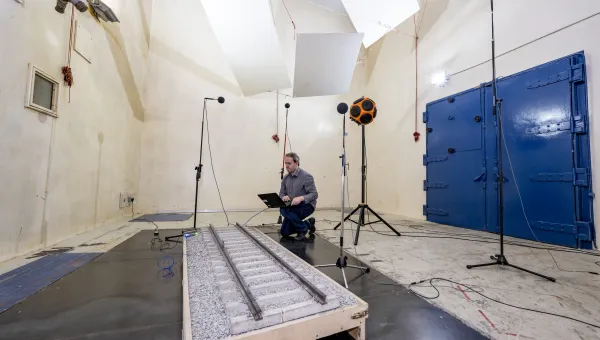
A permanent wire-mesh floor can be walked on and will support a distributed load of 8 people.
We can also install a load-bearing floor. It is made of removable glass-reinforced plastic grid panels above the wire-mesh floor.
The panels, supported on removable posts, are 600mm square. We can install as many panels as needed to support equipment under test or microphone stands. The floor can take a spread load of several tons.
A varnished chipboard flooring can be overlaid onto the load-bearing floor. This is useful when test standards need a ‘free field above a reflecting plane’ (hemi-anechoic conditions).
Control room
There is a control room next to the chamber which allows laptops, instrumentation and equipment to be placed outside the chamber. Cable ports give access to and from the chamber.
Research
We use the anechoic chamber for University research. It's also used for commercial testing and consultancy.
We work with industry, the private sector, public bodies and government agencies in the UK and Europe.
A list of the standards we test to is available at ISVR Consulting.
.