
About
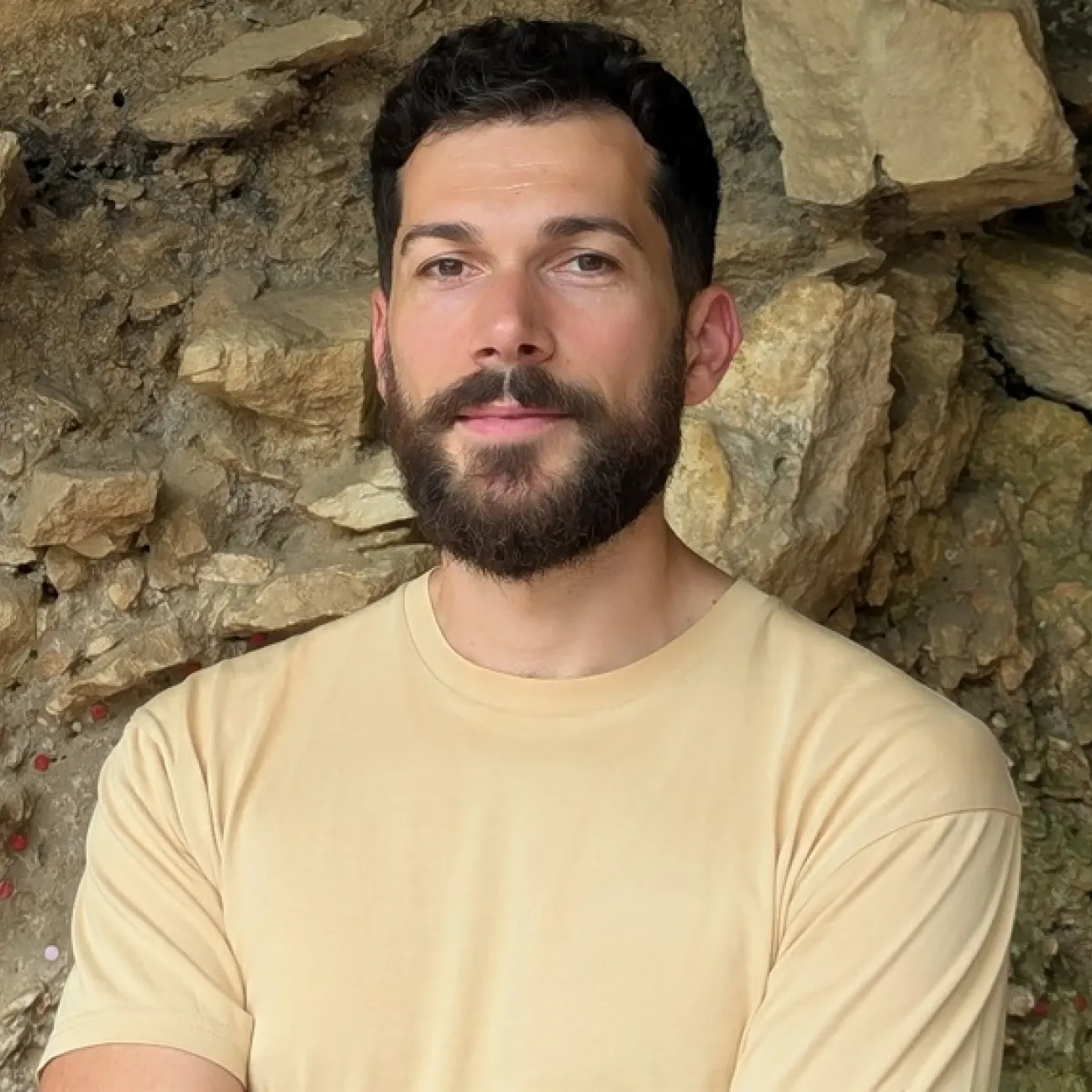
Armando is a Lecturer in Palaeolithic Archaeology at the University of Southampton and a member of the Centre for the Archaeology of Human Origins (CAHO). His research focuses on the biocultural dynamics of early Homo sapiens, with a particular emphasis on Mediterranean Europe, the Levant, and southern Africa. Armando specialises in the analysis of stone tools (lithics), which are the most abundant remains of human activity in deep time. Besides using traditional approaches, he is developing cutting-edge digital and computational methods for advancing lithic analysis.
Armando welcomes enquiries from prospective PhD students interested in the range of themes listed in his Research and Teaching tabs, and he is happy to mentor early-career researchers preparing applications for fellowship schemes such as the Marie Skłodowska-Curie Actions. Prospective applicants should get in touch well ahead of funding deadlines.
Personal website: www.armandofalcucci.com
Research
Research groups
Research interests
- Late Pleistocene hominin behaviour
- Lithic technology and experimental archaeology
- Computational archaeology and 3D visualisation
- Human-climate interaction and cultural transmission
- Open Science and digital heritage
Current research
My research investigates the interplay between technological development, mobility, and human–climate interactions during the Late Pleistocene. I strive to combine a range of traditional, computational, and digital methods in lithic analysis to assess the role of human dispersals, cultural transmission processes, and abrupt environmental shifts in early Homo sapiens behavioural variability. Currently, my research is divided into two major geographical settings: southern Africa and the northern and eastern Mediterranean Basin.
I am working on southern African sites, with a particular focus on Boomplaas Cave (Cango Valley, South Africa), to assess the extent to which interconnectivity among hunter-gatherer groups was influenced by the marked climatic fluctuations of MIS 3. This work was initiated thanks to a Marie Skłodowska-Curie Global Fellowship, under the RStone project.
My Mediterranean research focuses on the earliest stages of the Upper Palaeolithic, a period that sees major changes in human lifeways, possibly the result of several dispersal events of Homo sapiens groups and their interaction (and interbreeding) with Neanderthal populations. I am currently working on the reference sequence of Ksâr 'Akil in Lebanon and on several key Aurignacian sites in Italy. Here, I am directing the excavations at the site of Grotta del Fossellone on the Circeo promontory, central Italy.
Finally, I use experimental archaeology and 3D scanning to better understand the formation of lithic assemblages and thus better contextualise the archaeological findings. The creation of open-access digital repositories is an important step for advancing the field and enhancing the use of Open Science in archaeology. By applying Deep Learning to these new digital archives, I am developing new automated methods to explore the evolution of stone tool technologies.
Research projects
Completed projects
Publications
Teaching
My teaching strives to integrate theoretical and methodological approaches to the study of the human deep past, with a particular emphasis on hands-on engagement with material culture.
Modules
- ARCH6411 The Analysis of Palaeolithic Stone Tool Assemblages: working directly with archaeological and experimental assemblages to characterise stone tool technologies and build behavioural interpretations from them.
- ARCH2039 Experimental Archaeology: The Social Prehistory of Technology: reconstructing prehistoric technologies through experiment, and asking what social, economic and symbolic work objects did.
- ARCH2004 Introduction to European Prehistory: the dramatic changes in subsistence, social organisation, material worlds and cosmology over the last 10,000 years, leading up to the emergence of Rome as a major European power.
- ARCH1001 Human Origins (taught with Dr Rachel Bynoe): the biocultural evolution of early hominins, and the nature of the Palaeolithic record itself.
Supervision
I am interested in supervising undergraduate, master's, and PhD projects on Palaeolithic archaeology and lithic technology. Topics include: technological and behavioural variability in the Late Pleistocene, across the Initial Upper Palaeolithic, Ahmarian, Uluzzian, Aurignacian, and Gravettian of southern Europe and the Levant, and the Middle and Later Stone Age of southern Africa; cultural transmission, mobility and human–climate interaction; quantitative and computational lithic analysis in R; 3D scanning and geometric morphometrics; experimental archaeology; and open science and reproducibility.
Projects can draw on my own experimental lithic collections, on the Department's knapping and experimental workspace, on 3D scanning equipment, and on the open 3D models and attribute-based datasets I have published from Palaeolithic sites across Italy and the Levant. Further detail is on my supervision page.
External roles and responsibilities
Biography
I am a Palaeolithic archaeologist with a broad interest in Late Pleistocene hominin behaviour. I completed my BA in Cultural Heritage Sciences at the University of Rome II (Italy), with a year abroad at the University of Granada (Spain). A dissertation on the demise of the late Neanderthals across the Iberian Peninsula cemented my passion for Palaeolithic archaeology. This led to an MA in Quaternary, Prehistory and Archaeology at the University of Ferrara (Italy), with extended study and research stays at the University of Toulouse Jean Jaurès (France) and the Hebrew University of Jerusalem (Israel). At Ferrara, I started working on the Aurignacian thanks to Prof. Marco Peresani, who allowed me to work on the flagship site of Grotta di Fumane in the Venetian Prealps. My skills in fieldwork and lithic technology were further honed under the mentorship of Prof. Marie Soressi (Leiden University) and Prof. François Bon (University of Toulouse Jean Jaurès). This work expanded further through a PhD at the University of Tübingen (Germany), under the supervision of Prof. Nicholas Conard.
Between 2020 and 2025, I led the research project Investigating Early Upper Palaeolithic technological variability and cultural dynamics south of the Alps, funded by the German Research Foundation (DFG), which resulted in the reanalysis of pivotal stratigraphic sequences across Italy to better understand the biocultural processes that led to the formation and development of the Upper Palaeolithic. During this period, I conducted a funded research stay at Harvard University (USA) to analyse the lithic assemblage from the site of Ksâr 'Akil in Lebanon. I further expanded this work through a research stay at the University of Arizona (USA), where I had the privilege of working alongside Prof. Steven Kuhn to investigate the dispersal of early Homo sapiens across the Mediterranean Basin.
In 2024, I was awarded a Marie Skłodowska-Curie Global Fellowship for the RStone project (overall score of 100%), which I carried out between 2025 and 2026 at New York University (USA) and ICArEHB (Portugal). While I had to terminate this grant to join the University of Southampton in 2026, I am still working on MIS 3 southern African assemblages and developing new replicable methods in lithic analysis.
Prizes
- Marie Skłodowska‑Curie Global Fellowship (2024)
- Global Talent Endorsement (British Academy) (2026)