MicroMaterials Nanomechanical Instruments
Location: Building 30 room 1075
Nano-indentation
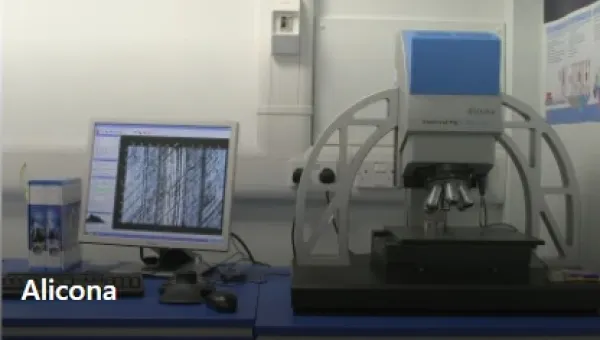
The NanoTest Vantage employs electromagnetic force application combined with capacitive depth measurement to characterise the elastic and plastic properties of materials at the nanoscale.
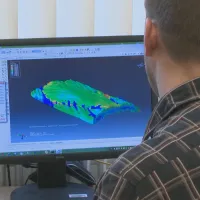
Hardness and modulus mapping
Hardness and modulus mapping enables the assessment of property distributions over large surface areas rather than isolated points. This approach is effective for identifying non-uniformities arising from structural defects, surface treatment variations, or changes at joints and interfaces. The high stability of the NanoTest Vantage ensures excellent reproducibility throughout extended test periods.
Depth profiling load/partial-unload technique
Conventional indentation methods typically measure properties at a single depth. In contrast, the load/partial-unload technique allows the evaluation of hardness and modulus as a function of depth below the surface. Load cycling within a single indentation enables multiple depth-dependent measurements to be obtained efficiently.
Indentation Creep
The system’s stability also supports long-duration tests such as indentation creep experiments. These tests allow reliable determination of creep-related parameters, including stress exponent and creep compliance. When combined with the high-temperature module, the technique can additionally be used to determine the activation energy of creep processes.
Nano-impact
Nano-impact testing is well suited to high strain rate contact conditions, with typical strain rates of 100–1000 s⁻¹ (1 s⁻¹ = 100%/ second), significantly exceeding those used in nano-indentation (0.0001–0.01 s⁻¹).
Advantages:
- single impacts for assessing work
- hardening, dynamic hardness and yield stress
- repetitive high strain impacts for fatigue evaluation
- clear identification of cycles to failure
- rapid, automated determination of S–N curves
- complements nano-indentation when toughness is critical and hardness measurements alone are insufficient
Nano-impact testing was originally developed to evaluate the toughness and fatigue fracture resistance of thin films and coatings. It also replicates highly loaded repetitive contact conditions, such as those encountered by high-speed machining tools for difficult-to-machine aerospace materials and components exposed to erosive wear in aerospace engines.
Laboratory studies demonstrate a strong correlation between nano-impact test results and the performance of coated systems operating under extreme intermittent contact conditions.
Repetitive contacts in nano-impact testing constitute true impact events, with the probe repeatedly separating from and re-impacting the sample surface at the same location.
Nano-impact testing on the NanoTest Vantage is simple, rapid and flexible. The capability may be integrated at the time of purchase or added to existing instruments via an Impact module.
Test severity and duration can be controlled through several parameters, including:
- probe geometry
- acceleration distance
- coil force
- impact angle
- number of cycles
- test frequency
Damage progression is monitored by continuously recording the position of the impacting diamond probe. A cube corner diamond indenter is commonly employed, as its geometry generates high contact strain, enabling fracture initiation within short test durations.
Nanoscratch
Thin films and coatings, typically ranging from a few nanometres (µm) to approximately 1 µm in thickness, require optimisation of both mechanical properties and tribological performance. This is commonly achieved using a combination of indentation and scratch testing. Conventional scratch tests, developed for thicker coatings, are unsuitable for such thin layers; instead, the nano-scratch and wear module provides an appropriate testing approach.
During testing, the sample is translated perpendicular to the scratch probe while the contact load is maintained constant or increased at a user-defined rate. Probe penetration depth and tangential (frictional) force are continuously monitored throughout the test. Both single-pass and multi-pass scratch tests can be performed, with multi-pass testing enabling the investigation of nano-wear and micro-wear behaviour.
Nano-fretting
Components in many applications are subjected to vibrational wear during service. While fretting tests are commonly performed at the macro-scale, the nano-fretting module enables the investigation of fretting and reciprocating wear at the micro- and nano-scale, addressing a previous gap in metrology.
This capability allows the study of the effects of small-amplitude oscillatory micro-motion on the durability of complex systems. An example is hip prostheses, where small debris particles trapped between articulating surfaces can progressively damage the contact interfaces.
Benefits of the NanoTest fretting module:
- high-cycle wear behaviour
- true nano-scale fretting behaviour
- reciprocating sliding wear
- integrated friction sensing for enhanced data interpretation
- flexibility to simulate in-service conditions
More detailed technical specifications for the listed equipment are available for internal staff use only. Please contact us for further information.