

About
The Computational Systems group has now been replaced by the Digital and Data Driven Methods group
Digital and Data Driven methods group page
Our research involves using computer simulations to help understand chemical problems. We work to develop new software and hard capabilities for data collection and analysis.
We cover a broad set of topics, including:
- predicting materials structure and properties
- computational drug design
- predicting chemical change
To aid our research, we use the University's 8000-core supercomputer - the largest supercomputer in any UK university.
Multiscale modelling
We're combining simulations from the quantum mechanical through to differential equation modelling of biochemical pathways. This will help us better understand, for example, the role of calcium signalling and its effect on certain metabolic diseases.
Classical and quantum mechanical methodology development
We're leading the development of new methodologies for the simulation of matter. This ranges from linear-scaling density functional methods, to classical and combined quantum mechanics and molecular mechanics methods for calculating protein-ligand binding affinities.
Drug design, binding, delivery, transport and metabolism
We develop and apply simulation-based methods to the drug development process. This includes predicting drug binding geometries and affinities and also modelling drug transport.
Semiconductor and metallic nanoparticles
We study the electronic and structural properties of a variety of nanostructures, such as semiconductor nanorods. These can act as luminescent chromophores with optical properties that can be tuned by adjusting their size and shape – changing the potential that confines electrons and holes.
Membrane transport phenomena
We use very-large scale simulation models of biological systems, focusing specifically on the membrane environment, and including realistic models of bacterial membranes, to understand how the complex interplay of molecular interactions delivers biological function.
Experimental design and refinement
This includes:
- automated laboratory monitoring
- electronic lab notebooks
- advanced methods for data storage
- curation and sharing
- using distributed computational resources for data storage and computation
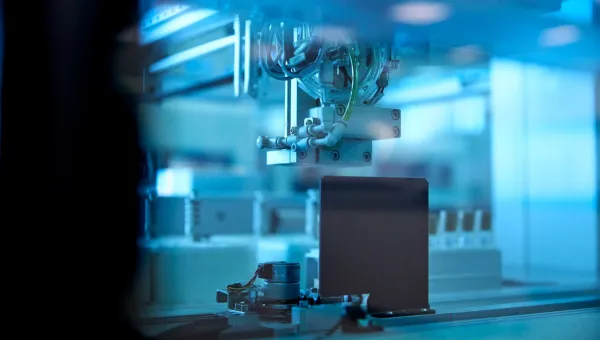
Revolutionising ways to find essential materials
A Southampton Chemistry researcher is using pioneering computational chemistry modelling methods to make positive changes in everything from clean fuel to healthcare.
People, projects and publications
People

I’m excited by the promise of predictive computational methods for transforming the way that we discover new materials.